Ever stared at a blank sheet of paper, imagined a splash of colour, and then felt that knot of doubt? You’re not alone. Many hobbyists, budding creative entrepreneurs, and even parents looking for a calming activity for their kids hit that wall when they think about learning watercolor online.
What’s tricky is that the digital world is flooded with courses that promise “instant mastery” but often leave you guessing which brush to use, how much water to add, or whether your pigments will blend the way you expect. In our experience at CreativiU, the biggest breakthrough comes when you combine solid fundamentals with a supportive community that can answer those “wait, what?” moments in real time.
Take Maya, a stay‑at‑home mom who wanted a creative outlet after the kids went to bed. She signed up for a beginner’s watercolor series, followed the step‑by‑step video lessons, and within two weeks she was confidently painting simple garden scenes for her living room. Or Alex, an aspiring freelance illustrator, who used an online course to sharpen his colour‑mixing skills, eventually landing a commission for a children’s book illustration. Those stories aren’t magic; they’re the result of clear guidance, practice exercises, and feedback loops that keep you moving forward.
So how do you pick a course that actually works for you? Start by asking yourself three quick questions: Do you need live instructor feedback, or are you comfortable with pre‑recorded demos? How much time can you commit each week? And finally, does the platform foster a community where you can share progress and get tips?
Once you have those answers, you’ll be ready to dive into a course that matches your schedule, learning style, and creative goals. For a curated list of top‑rated beginner programs that we’ve vetted, check out our Top Picks for the Best Online Watercolor Painting Course for Beginners in 2024. It breaks down each option by curriculum depth, feedback options, and price, so you can compare at a glance.
Here are a few actionable steps to get you started right now:
- Set up a dedicated, well‑lit workspace with a simple tabletop easel, a set of student‑grade watercolor paints, and a few good brushes.
- Sketch your composition lightly with a pencil before you dip into paint – this helps you plan values and avoid over‑working the paper.
- Commit to a short, consistent practice schedule – even 15 minutes a day builds muscle memory faster than occasional marathon sessions.
- Join the course’s community forum or Discord channel; ask for critique on one painting per week and offer feedback to others.
By following these steps and choosing a course that offers real‑time feedback, you’ll turn that initial hesitation into steady progress, and soon enough you’ll be looking forward to that first fresh wash of colour on every new canvas.
TL;DR
A watercolor painting online course gives you step‑by‑step video lessons, guided practice exercises, and a supportive community so you can turn blank pages into confident washes.
Start with a simple sketch, practice 15 minutes daily, and use feedback loops to watch your skills blossom faster than juggling random online tutorials.
Choosing the Right Watercolor Painting Online Course Platform
So you’ve decided a watercolor painting online course is the next step, but the market feels like a never‑ending gallery of promises. I get it – you want a space that actually helps you grow, not just a collection of pretty videos.
1. Know how you learn best
Do you thrive on real‑time feedback, or are you comfortable pausing a pre‑recorded demo and rewinding as many times as you need? Some platforms offer live Zoom workshops where an instructor can spot a shaky wash and suggest a tweak on the spot. Others give you a library of crisp lessons you can binge on a Sunday afternoon.
Ask yourself: “Do I need that instant human eye, or can I learn at my own pace?” Your answer will narrow the field dramatically.
2. Community matters more than you think
Picture this: you finish a tricky gradient, post it in the course forum, and within an hour someone suggests a tiny water‑to‑pigment tweak that makes the colour pop. That kind of supportive vibe keeps motivation high.
Look for platforms that host a Discord or private Facebook group, not just a static comment box. A thriving community means you’ll get critique, encouragement, and maybe even collaboration opportunities.
Speaking of a good cup of focus, many of our members swear by a specialty coffee subscription to kick‑start their painting sessions. Brew a fresh pour‑over, settle into your easel, and let the aroma fuel your brushstrokes.
That quick video walk‑through shows how to set up your digital workspace – from lighting to file organization – so you can focus on the paint, not the tech.
3. Test the tech before you commit
Nothing kills creative flow faster than a clunky LMS. Check if the platform works on both desktop and tablet, whether videos play at 1.5x speed, and if downloadable resources (PDF cheat sheets, colour charts) are easy to access.
Most platforms give a free trial week. Use it to upload a test painting, join a live chat, and see if the navigation feels intuitive. If you’re on a tight budget, look for a freemium tier that still offers community access.
When you’re ready to compare options, our top picks for beginner watercolor courses break down each platform’s feedback style, community size, and tech reliability.
Don’t forget the basics before you dive into any course – a good sketch sets the stage. Choosing the right pencil can make that first line feel confident, so check out the best pencils for drafting to ensure your underdrawings are as solid as your colour washes.
Finally, create a dedicated nook for your practice. A simple table, a good lamp, and a splash‑proof mat keep the mess contained and the vibe focused.
By aligning your learning style, community needs, and tech comfort, you’ll land on a platform that feels less like a purchase and more like a creative partnership.
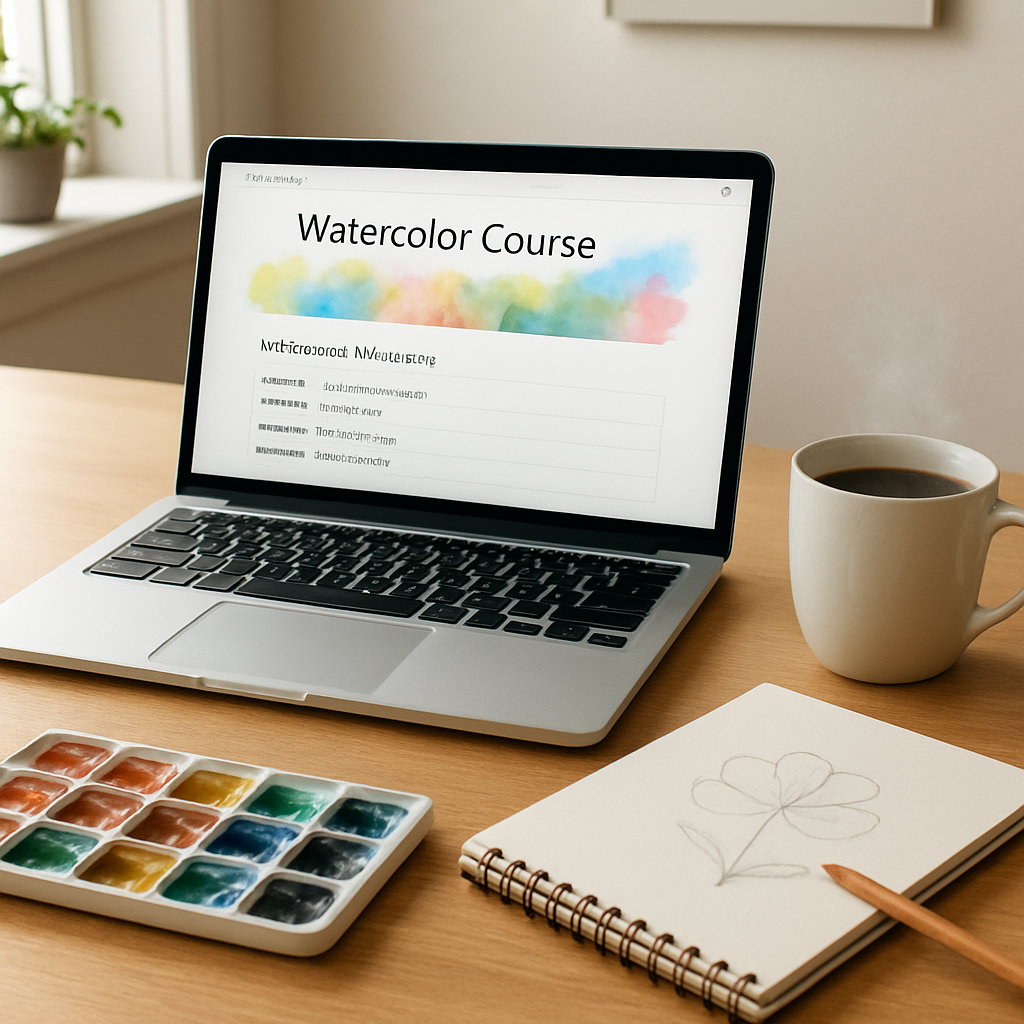
Setting Up Your Digital Workspace for Watercolor Lessons
First thing’s first: if you’re scrolling through a watercolor painting online course on a phone while the coffee cools, you’ll end up frustrated. A dedicated digital workspace takes the guesswork out of “where do I click?” and lets you focus on the paint, not the tech.
Choose a device that feels comfortable
Most of us start on a laptop because it’s portable and cheap enough to replace. But not all laptops are equal. Look for a screen that’s at least 13 inches, with a resolution that lets you see brush strokes clearly. If you can, upgrade to a monitor with an IPS panel – the colours stay true and the viewing angles stay wide, which matters when you’re comparing your work to a video demo.
Do you prefer a tablet? A stylus‑enabled iPad or Android tablet can double as a sketchpad for planning washes before you dip a real brush. The key is low latency; you don’t want a laggy pen that makes you feel like you’re drawing in molasses.
Set up lighting that mimics daylight
Natural light is the gold standard for watercolor, and your screen should reflect that. Position your workstation near a window, or invest in a daylight‑balanced LED lamp (5000 K). Avoid harsh overhead fluorescents – they can wash out the subtle gradients you’re trying to learn.
Take a moment to notice how the light hits your paper. Does a shadow fall on the right side? Adjust the lamp until the illumination is even, just like the lighting in the course videos. This small tweak makes colour matching between screen and paint feel less like a guessing game.
Organize your digital files like a studio shelf
Think of your computer folders as shelves for brushes and paints. Create a top‑level folder called “Watercolor Course” and inside it make subfolders for “Lesson Videos,” “Reference Photos,” “Practice Sketches,” and “Finished Paintings.” Naming files with dates (e.g., 2026‑02‑05_GardenWash.jpg) lets you track progress without scrolling forever.
Back up once a week to a cloud service or an external drive. If your internet drops in the middle of a live critique, you’ll still have a copy of your work to share later.
Set up the right software environment
Most courses run on platforms like CreativiU, which provide a browser‑based dashboard. Make sure you use a modern browser (Chrome, Edge, or Safari) and keep it updated. Disable pop‑up blockers for the site, otherwise you might miss a feedback notification.
If you like taking notes, open a simple text editor or a note‑taking app side‑by‑side with the video. Jot down timestamps (“3:45 – wet‑on‑wet technique”) so you can jump back without rewinding the whole lesson.
Ergonomics matter as much as colour theory
Imagine sitting for an hour with your shoulders hunched, hand cramped, and the mouse at arm’s length. That tension shows up in shaky brushwork. Adjust your chair so your feet rest flat on the floor, your elbows are at a 90‑degree angle, and the screen sits at eye level. A small footrest can be a game‑changer if your desk is too high.
Take a 5‑minute stretch break after each lesson. Reach for the ceiling, roll your shoulders, and shake out your hands. You’ll notice your brush control improves once you return to the paint.
Test your internet before a live session
Live Q&A or critique sessions are the sweet spot of a watercolor painting online course, but they rely on a stable connection. Run a quick speed test; you need at least 3 Mbps download and upload for smooth video. If you’re on Wi‑Fi and the signal is weak, move closer to the router or plug in an Ethernet cable.
Having a backup plan (like a phone hotspot) saves you from the embarrassment of “Sorry, I lost you” during a critical feedback moment.
Make it a ritual, not a chore
Now that the tech is sorted, turn the workspace into a mini‑ritual. Light a scented candle, brew your favorite tea, and cue a playlist that’s low enough to hear the brush on paper. When the environment feels inviting, the learning curve flattens, and you’ll find yourself looking forward to each lesson.
So, what’s the next step? Grab a notebook, map out those folders, and spend ten minutes tweaking your lighting. In a week you’ll notice the difference – smoother washes, quicker feedback, and more joy in every stroke.
Essential Supplies and Materials for Online Watercolor Classes
Ever opened a watercolor kit and felt like you’ve just been handed a mystery box? You’re not alone – the first step feels like a puzzle, but once the pieces click together the whole process becomes way less intimidating.
Here’s the bare‑bones inventory you really need for a smooth online learning experience: a reliable pad of watercolor paper, a decent set of paints, a handful of brushes, a palette (or a simple ceramic plate will do), a water container, some masking fluid, and a few housekeeping tools like paper towels and tape. Anything beyond that is nice to have, not essential.
Paper – the foundation of every wash
Weight matters. Aim for 140‑300 gsm (grams per square metre) cold‑press paper if you’re just starting. The heavier the sheet, the less it buckles when you splash water. Cold‑press gives you a slightly textured surface that holds pigment well, while hot‑press is smoother for detailed work. If you’re a parent juggling kids’ art time, a pad of 250 gsm cold‑press paper is a safe middle ground – sturdy enough for experimentation, yet still affordable.
Paints – tubes vs. pans
Student‑grade pans are budget‑friendly and perfect for short practice sessions. Professional tubes offer richer pigments and smoother blends, which matter when you’re chasing subtle gradients for a client project. A common starter set is 12 pan student grade plus one tube of a primary colour you love – you’ll quickly learn how to mix any hue you need.
Brushes – size and material
Don’t buy a whole brush cabinet right away. Start with a round 2 mm for fine lines, a round 6 mm for washes, and a flat 1/2 inch for broad strokes. Synthetic sable brushes give you decent snap without the price tag of true sable, and they clean up easily. If you’re an aspiring freelance illustrator, consider adding a small mop brush for soft, atmospheric effects.
Palette, water, and the “extras”
A shallow plastic palette with a well for clean water keeps your workspace tidy. A separate cup for dirty water prevents colour contamination – a tiny habit that makes a big difference in colour accuracy. Masking fluid (or liquid frisket) lets you preserve white highlights; a simple piece of painter’s tape can double as a mask for straight edges.
Real‑world example: Maya, a stay‑at‑home mom who joined our beginner course, swears by a 250 gsm cold‑press pad, a 12‑pan student set, and a round 6 mm brush. Within two weeks she was confident enough to paint a garden scene for her living room, and she never missed a class because her supplies were low‑maintenance.
Actionable checklist
1. Pick a paper weight (140‑300 gsm) and buy one pad – you’ll know when it’s right once you see the paper stay flat after a wash.
2. Choose either a student‑grade pan set or a single‑tube starter kit – whichever fits your budget.
3. Grab three brushes: round 2 mm, round 6 mm, flat 1/2 inch.
4. Set up a shallow palette, two water cups, and a roll of painter’s tape.
5. Add masking fluid if you plan to keep bright whites in your compositions.
Before you sketch your first wash, you’ll need a reliable pencil for the underdrawing. A good drafting pencil makes the difference between a shaky outline and a confident line. For options, check out this guide on the best pencils for drafting – it walks you through hardness, grip, and price points.
Once your kit is assembled, the next logical step is to see how those tools work together in a structured setting. Our interactive watercolor painting course with instructor feedback breaks down each material’s role, shows you live demos, and even offers a printable checklist you can hang above your workspace.
So, what’s the final take‑away? Grab the basics, test them during a short practice session, and tweak one item at a time. In a week you’ll notice which paper texture you prefer, which brush gives you the smoothest wash, and whether you need a larger palette. That little loop of experimentation plus feedback is what turns a hesitant hobbyist into a confident watercolorist.
Step-by-Step Learning Path: From Basics to Advanced Techniques
Ever felt like you’re staring at a blank page and wondering where to begin? You’re not alone. The first few lessons of any watercolour painting online course can feel like learning a new language, but a clear roadmap makes the journey feel like a conversation over tea.
1. Foundations – Getting Comfortable with the Basics
Start with the fundamentals: colour theory, water‑to‑paint ratio, and how different papers react. Spend a week practising simple washes on cold‑press paper; notice how the grain catches the pigment. The goal isn’t perfect results, it’s building confidence in the medium.
Tip: Keep a short sketchbook handy and label each wash with the ratio you used. When you look back, you’ll see patterns and avoid repeating mistakes.
2. Building Technique – From Washes to Forms
Once you can lay down a smooth wash, move onto shape‑building exercises. Try a series of still‑life studies – a single apple, a mug, a leaf. Focus on one technique per session: wet‑on‑wet for soft gradients, dry‑brush for texture, or glazing for depth.
Ask yourself, “What’s the next small step that will stretch my comfort zone without overwhelming me?” If you’re a parent fitting practice into bedtime routines, a 15‑minute focused drill works wonders.
3. Introducing Colour Relationships
Now that you can control water, explore colour mixing. Start with the three primaries and create a small palette of 6–8 hues. Mix a new shade each day and paint a swatch chart. This habit turns abstract theory into a tactile reference you can reach for during a live critique.
In our experience at CreativiU, students who keep a colour chart report faster progress because they can instantly visualise the mix they need for a particular mood.
4. Structured Feedback Loops
Feedback is the secret sauce. Join a community where you can post a photo of your latest piece and receive pointed tips. If you prefer a more guided approach, consider a class like Emily Lex’s simplified watercolor online class. It offers short videos you can replay, plus a resource list of supplies – perfect for reinforcing the basics before you move on.
Schedule a weekly “show‑and‑tell” with a peer or mentor. Even a five‑minute critique can highlight a stray brushstroke or a missed colour harmony that you’d otherwise overlook.
5. Intermediate Projects – Adding Narrative
At this stage, give your practice a purpose. Choose a simple theme – a garden, a city skyline, or a favourite recipe. Sketch the composition lightly, then layer washes, glazes, and details. The narrative element keeps you engaged and turns technique into storytelling.
Don’t worry if the result looks messy; the mess is part of the learning. Capture the piece, note what worked, and plan a tiny tweak for the next session.
6. Advanced Exploration – Pushing Boundaries
Now you’re ready for specialised techniques: lifting, masking fluid tricks, and mixed‑media overlays. Pick one advanced skill each month and dedicate a focused project to it. For example, experiment with lifting by re‑wetting a dry area and blotting with a dry brush to reveal highlights.
Remember to revisit earlier fundamentals regularly. A quick 10‑minute wash before tackling a complex piece keeps your hand steady and your confidence high.
Quick Reference Table
| Stage | Core Skill | Suggested Practice |
|---|---|---|
| Foundations | Water‑to‑paint control, paper texture | Daily 5‑minute wash on cold‑press paper, label ratios |
| Technique Building | Wet‑on‑wet, dry‑brush, glazing | Weekly still‑life study focusing on one technique |
| Advanced Exploration | Lifting, masking fluid, mixed‑media | Monthly project dedicated to one advanced method |
So, what does the next week look like? Grab a sketchbook, set a timer for 10 minutes, and try a simple sky wash. Note the water‑to‑paint ratio, share the photo in your course’s community, and watch how a quick tip can shave minutes off your learning curve. Keep repeating, and before you know it, you’ll be creating pieces you’d proudly frame on the wall.
How to Stay Motivated and Track Progress in an Online Watercolor Course
Ever opened your sketchbook and felt that familiar dip‑in‑the‑bucket of doubt? You’re not alone. The biggest hurdle in a watercolor painting online course isn’t the technique – it’s keeping the spark alive long enough to see real improvement.
Set a micro‑goal that feels doable
Instead of “paint a whole landscape this week,” try “finish a 5 × 7 cm sky wash in 20 minutes.” That tiny target gives you a win, and each win builds momentum. When the timer dings, celebrate the fact that you actually painted something – even if the sky looks more “stormy” than “serene.”
So, what should you do next? Write down three micro‑goals for the upcoming 48 hours and stick them somewhere you’ll see them – a sticky note on your monitor or the back of your phone.
Use a simple progress‑tracker template
Grab a spreadsheet or a plain notebook and create columns for Date, Lesson, Technique Practiced, Time Spent, and One‑Sentence Reflection. Fill it in right after each session. The act of logging forces you to pause and notice patterns, like “I spend 10 minutes too much on wet‑on‑wet before the paper dries.” Over time those notes become a personal cheat‑sheet.
Imagine you’re a parent squeezing in practice after bedtime. Seeing a row that says “30 min – wet‑on‑wet – felt steady” can be the nudge you need to repeat that routine tomorrow.
Leverage the course community for accountability
Most online watercolor courses have a forum, Discord, or Facebook group. Post a quick photo of your micro‑goal outcome and ask for one concrete tip. When you get a reply like “try a lighter wash on the horizon to keep the sky brighter,” you’ve just turned a solitary habit into a collaborative loop.
In our experience, learners who share at least one piece a week are 1.8 × more likely to finish the course. The exact figure isn’t magic – it’s simply the result of regular social reinforcement.
Schedule “review days” instead of just practice days
Every seventh day, skip new painting and spend 15 minutes scrolling through your tracker. Pick two older entries and compare them side by side. Look for subtle shifts: a smoother gradient, a cleaner edge, or a more confident colour mix. Write a one‑line note like “notice softer transitions” and set a tiny tweak for the next week.
Does this really work? Think about it this way: you’re training the same muscle you use to hold a brush – the habit of observing your own work. The more often you do it, the sharper your eye becomes.
Turn setbacks into data points
Maybe a wash ran too far or a colour turned muddy. Instead of labeling it a failure, log the cause: “used too much water on cold‑press paper”. Then add a corrective action: “next time, limit water to three drops per brushstroke.” Over a month you’ll have a personal troubleshooting guide that no generic tutorial can match.
Picture this scenario: you’re working on a cityscape and the sky looks flat. You glance at your tracker, see that you’ve been using the same 1:5 water‑to‑paint ratio for three days, and decide to experiment with a 1:3 mix. Suddenly the sky gains depth – all because you turned a note into an experiment.
Make it a ritual, not a chore
Set the scene: a cup of tea, a candle flickering, the window letting in soft daylight. When you cue the same sensory details each time, your brain starts associating them with focused painting. That cue alone can lift motivation on days when the blank page feels intimidating.
And remember, motivation isn’t a constant stream – it’s a series of peaks and valleys. By having micro‑goals, a tracker, community feedback, and a ritual, you create enough peaks to carry you through the valleys.
Ready to put it into action? Choose one of the steps above, set a timer for ten minutes, and start a sky wash. Log the result, share it, and watch how quickly the momentum builds.
Additional Resources: Communities, Tutorials, and Certification Options
Where to Find Communities that Click
Ever felt like you were painting in a vacuum? That’s where a good community swoops in, like a friendly neighbor who brings over fresh herbs when you’re short on basil.
Most watercolor painting online courses ship you into a private forum or Discord, but you can also dip into larger groups on Reddit’s r/Watercolor, Facebook hobby pages, or even niche Slack channels that focus on illustration for books.
What’s the trick? Look for spaces that encourage critique, not just applause. A thread where members post a “work‑in‑progress” and ask for one concrete tip beats a gallery of endless praise because it pushes you to solve a real problem.
So, what should you do next? Join a couple of groups, introduce yourself with a short sketch, and ask for a quick “what’s one thing I could tighten up?” You’ll be surprised how fast the feedback loop speeds up.
Curated Tutorials and Free Walk‑Throughs
If you’re hunting for bite‑size tutorials that fit into a coffee break, check out the short video lessons on Emily Lex’s simplified watercolor online class. They break down everything from water‑to‑paint ratios to fixing a stray streak, and you can replay them whenever you need a refresher.Emily Lex’s simplified watercolor online class also includes a printable supply cheat‑sheet, which is gold for beginners who keep wondering, “Do I need a flat brush or a round one?”
Another handy resource is the free “30‑day watercolor challenge” you can find on many art blogs. Each day gives you a tiny prompt – a single leaf, a gradient sky, a splash of colour – and the goal is to finish it in under 20 minutes. The real power is in the habit, not the masterpiece.
And don’t overlook YouTube channels that focus on live‑painting sessions. While we can’t link them directly here, a quick search for “live watercolor wash tutorial” will surface streams where you can paint along in real time, pausing whenever you need to catch up.
Certification Paths for the Serious Learner
If you’re eyeing a freelance gig or want that extra line on your résumé, a certificate can be a confidence booster. Many platforms now offer a “completion badge” that you can embed on your portfolio site, but a more recognized credential comes from art schools that partner with online providers.
Look for courses that include a final project reviewed by a professional instructor, followed by a digital certificate. The assessment usually involves uploading a high‑resolution photo of your work, a brief reflection on your process, and maybe a short quiz on colour theory.
What’s the upside? Clients often ask for proof of training before they hand over a budget. A certificate from a reputable source tells them you’ve invested time and met a standard, which can shorten the negotiation phase.
Still, don’t treat a certificate as a magic ticket. Pair it with an active community presence – share your certified piece, ask for feedback, and keep the momentum going. That combination of proof and ongoing practice is what turns a hobbyist into a professional.
Putting It All Together
Here’s a quick checklist you can pin above your workspace:
- Join at least two active watercolor communities (Discord, Reddit, Facebook).
- Bookmark a tutorial series you love – like Emily Lex’s class – and schedule a weekly 15‑minute replay session.
- Pick a certification‑friendly course if you need credentials, and set a deadline for the final project.
- Share one piece a week in your community, ask for one specific improvement, and log the feedback in a simple spreadsheet.
By weaving together community chatter, focused tutorials, and a recognisable certificate, you create a self‑reinforcing loop that keeps you painting, learning, and earning. And the best part? You get to do it while sipping that cup of tea you set up for your ritual.
Conclusion
We’ve walked through everything from picking the right paper to building a feedback loop, and you’ve probably felt that familiar mix of excitement and doubt that starts any new creative habit.
So, what does all this mean for you? It means you already have a clear roadmap: join a supportive community, schedule bite‑size practice sessions, and treat each lesson like a coffee break with a friend.
Remember, a watercolor painting online course isn’t a magic wand. The real transformation happens when you combine the structured lessons with the tiny rituals – a fresh cup of tea, a tidy palette, a quick notebook entry – that keep the momentum flowing.
If you’re a hobbyist, try posting one sketch a week and ask for a single, specific tip. If you’re a creative entrepreneur, pair the course certificate with a short portfolio piece and share it on your socials. Either way, the habit of logging progress turns vague goals into measurable wins.
And here’s a tiny action step you can take right now: open your planner, block a 15‑minute slot for the next lesson, and write down the one skill you want to improve. Hit “start” and watch the brush strokes line up with your intention.
When the paint dries, you’ll see that the journey you’ve built is as rewarding as the final artwork. Keep experimenting, keep connecting, and let the watercolor painting online course be the spark that lights your creative side every day.
FAQ
What makes a watercolor painting online course different from a traditional in‑person class?
When you log in, the lesson is right there on your screen, so you can pause, rewind, or speed up whenever you need. That flexibility means you can fit a 15‑minute wash into a coffee break instead of carving out a whole afternoon. Plus, the community lives in a forum or Discord, so you get instant written feedback without waiting for the next studio crit.
How much time should I set aside each week to see real progress?
Think of it like a habit you’d build around a daily walk – consistency beats marathon sessions. Aim for three 20‑minute practice blocks spread across the week. In each block, focus on one technique (wet‑on‑wet, glazing, or colour mixing) and jot a quick note about what worked. After four weeks you’ll notice smoother washes and more confidence, even if you only practiced half an hour total each week.
Do I need expensive supplies to start a watercolor painting online course?
Not at all. A modest student‑grade pan set, a cold‑press paper pad (140‑250 gsm), and a couple of synthetic sable brushes are enough to follow most beginner lessons. The key is consistency, not the brand name on the tube. If you find yourself loving the medium, you can upgrade one item at a time – maybe a professional pigment tube or a larger brush – without breaking the bank.
Can I get personalized feedback in an online course?
Absolutely. Most platforms, including CreativiU, embed a comment thread or a Discord channel where you can upload a photo of your latest wash. Instructors or peers will point out one specific thing to tweak – like “lighten the water‑to‑paint ratio on the sky” – and you can apply that tip right away. The written record also becomes a handy reference for future projects.
What if I fall behind or miss a live session?
That’s where the on‑demand library shines. Every lesson is recorded, so you can catch up at your own pace. A good habit is to schedule a “review day” each weekend: watch the missed video, practice the highlighted technique, and add a note to your progress tracker. Knowing the content is always waiting removes the pressure of “live‑only” learning.
Is there a way to track my improvement over time?
Yes – a simple spreadsheet works wonders. Create columns for Date, Lesson, Technique, Time Spent, and a one‑sentence reflection. After each session, fill it in. Over a month you’ll spot patterns, like “my glazing time drops from 10 minutes to 6 minutes.” You can also snap a before‑and‑after photo pair every two weeks and line them up to see colour vibrancy and brush control improve.
Will completing a course help me earn money as a creative entrepreneur?
Finishing a structured course gives you a portfolio piece you can showcase on a website or social feed, and many clients look for proof of training. Pair the certificate with a short project – say, a custom illustration for a local coffee shop – and share the result in the course community for a testimonial‑style endorsement. That combo of credential and real work often opens doors to freelance gigs or small‑scale product sales.
Leave a Reply