Four Patches
Half Square Triangles or HST: Half square triangle units are basically squares divided into two 90-degree triangles. Each triangle takes up half of the whole area in the square.
Making a perfect Half Square Triangle Block
How to Make Easy Half Square Triangle Units for Quilts By JANET WICKELL
Flying Geese: This block is made up of triangles arranged to create the shape of a flock of geese in flight.
How to make flying gueese using Block Loc Ruler
QUILTING SKILLS – FLYING GEESE – BEGINNER TO ADVANCED
Chess Flying Gueese Free Pattern
Flying Gueese Through The Mountains – Free Quilt Pattern
Sawtooth Star: You need nine units to make this block. It includes a center square, four outer squares, and four flying geese units.
How To Make A Sawtooth Star Block
Nine-Patch: This is one of the most basic quilting blocks, and it is made up of nine squares arranged in a three-by-three grid.
Log Cabin: This block is made up of strips of fabric arranged in a circular pattern, with the center square representing the “cabin” and the surrounding strips representing the “logs.”
Railroad: This block is made up of squares and triangles arranged to create the illusion of railroad tracks.
Pinwheel: This block is made up of squares and triangles arranged to create the shape of a pinwheel.
Drunkard’s Path: This block is made up of curved pieces of fabric arranged in a circular pattern.
Storm at Sea: This block is made up of squares and triangles arranged to create the illusion of waves on the ocean.
Bear’s Paw: This block is made up of squares and triangles arranged to create the shape of a bear’s paw.
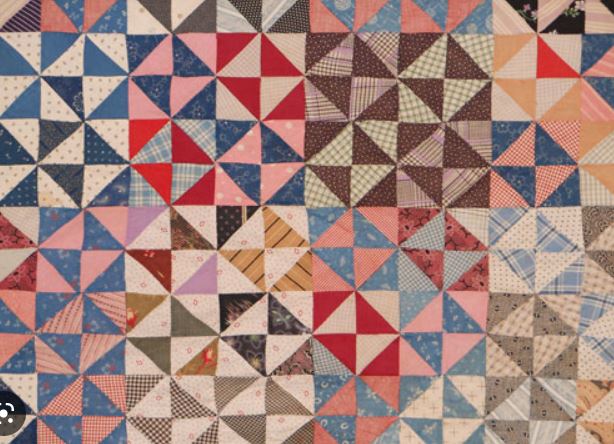
Broken Dishes: Broken Dishes is a classic design made of triangles forming small four-patches in a square. By turning them at various angles, the ‘broken pieces’ effect is achieved. Quilting with the popular pattern of the 1790s is one of the earliest and most frequently seen designs in history. Examples of this design have been around ever since its origin.
Churn Dash: This block is made up of squares, triangles, and rectangles arranged in a simple but striking pattern.
Double Wedding Ring: This block is made up of interlocking rings and curves, creating a complex and elegant design.
Drunkard’s Path: This block is similar to the Bear’s Paw block, but with curved pieces of fabric instead of triangles.
Grandmother’s Flower Garden: This block is made up of small hexagonal pieces arranged in a floral pattern.
Honeycomb: This block is made up of hexagons arranged in a honeycomb pattern.
Jacob’s Ladder: This block is made up of squares and rectangles arranged in a diagonal pattern.
LeMoyne Star: This block is made up of interlocking diamonds and triangles, creating a star-like pattern.
Meadowland Block:
Ohio Star: This block is made up of diamonds and triangles arranged to create a star shape.
Pineapple: This block is made up of triangles arranged in a pineapple-like shape.
Rail Fence: This block is made up of strips of fabric arranged in a zig-zag pattern.
Sawtooth Star:
Shoofly: This block is made up of squares, rectangles, and triangles arranged in a circular pattern.
Star of Bethlehem: This block is made up of interlocking diamonds and triangles, creating a star-like pattern.
Sunflower: This block is made up of squares, triangles, and circles arranged to create the shape of a sunflower.
Tumbling Blocks: This block is made up of interlocking three-dimensional cubes, creating a geometric pattern.

Weathervane: The famed Weathervane quilt block can be easily crafted with just three colors. Not only is this block simple and quick, but it is also great for those who are new to quilting. Furthermore, there are many variations of the Weathervane quilt block that can be explored.
Weathervane Quilt Block Pattern – a Free Tutorial by Elaine Huff
Windmill: This block is made up of squares, triangles, and diamonds arranged in a circular pattern.
Woven: This block is made up of interlocking strips of fabric, creating a woven or basket-like pattern.
Quilt Discovery Experience – Homestead National Historical Park (U.S. National Park Service)
Leave a Reply